
Retail banking has transformed dramatically over the past generation. Branch counters gave way to apps and digital channels, but the real complexity still sits behind the screen. Every new platform has solved one problem and quietly created another. Core systems remain fragmented, data is duplicated across departments, and even simple customer updates can travel through a maze of systems before anything actually changes.
What banks need now is not another expensive transformation programme but a way to make what they already have worked together. The idea of open source offers a practical route forward.
Open source is not about sharing everything; it is about agreeing on what should be shared - the essential building blocks that make systems interoperable. In any mature industry, collaboration begins when organisations realise they are all solving the same problems. Banking is reaching that point. Shared standards can provide the foundations, leaving each institution free to innovate on top.
The Common Domain Model (CDM) is a clear example of this in action. Developed through collaboration between ISDA, ICMA, ISLA, and FINOS members, it gives the industry a single language for describing financial products and lifecycle events. The model has already simplified how capital-market firms report, reconcile, and comply. Transactions defined under CDM mean the same thing everywhere, which eliminates translation errors and saves countless hours of reconciliation.
Retail banking can apply this same discipline to its own environment. Every product - deposits, loans, payments, and savings - has its own system, naming convention, and workflow. A deposit in one system might be a “credit,” while another calls it an “incoming transaction.” The difference seems minor, but multiplied across dozens of platforms it creates confusion, waste, and risk. Adopting CDM would mean that each event is described once, consistently, and understood everywhere.
The change goes far beyond data. For people working inside the bank, it restores clarity. Teams that used to spend days validating numbers can focus on serving customers. Regulatory submissions become faster and more reliable. Even customer service improves, because when data is consistent, answers are consistent too.
Alongside CDM sits another open standard: FDC3. It focuses on how software applications communicate with each other. Where CDM defines the meaning of data, FDC3 allows one application to trigger another securely and seamlessly. Together, they bring order to what has often been a patchwork of disconnected tools.
Imagine a branch or contact-centre agent moving between different applications during a customer conversation. Today, they often rekey information or switch screens repeatedly. With FDC3, those systems could share context instantly. When the agent opens a customer record in one application, others automatically update. Tasks that took minutes can happen in seconds.
This combination - CDM for structure and FDC3 for communication - creates a foundation where innovation becomes faster and safer. It reduces integration cost, improves resilience, and gives regulators confidence that the underlying logic of a transaction remains the same across its entire lifecycle.
The benefits of open source are not purely operational. They signal a cultural change in how the industry views progress. Instead of each bank building its own private version of the same basic functions, open standards encourage institutions to collaborate on the foundation and compete on the experience. This is how industries mature. Telecommunications did it with internet protocols; manufacturing did it with quality standards. Banking is now moving the same way.
To start, banks do not need to overhaul everything at once. Small steps matter. Identify one area where duplication or confusion slows progress - perhaps customer onboarding or payments reconciliation - and map it to CDM. Test how that standardisation improves speed, accuracy, and transparency. Engage with FINOS working groups to share learning and refine the model further. Every experiment adds value not just for one institution but for the sector as a whole.
The open-source model also builds resilience. When standards are maintained by a community rather than a single vendor, they evolve with the industry’s needs. That shared stewardship ensures that innovation is not locked away but continually improved through collective experience.
Retail banking’s next phase will not be defined by technology alone. It will be defined by trust - the trust that comes from systems that work together and data that holds its meaning from one end of the organisation to the other. Open collaboration is the mechanism to restore that trust.
The lesson from capital markets is clear: when competitors come together to define the basics, everyone wins. Retail banking can do the same. By building shared infrastructure through open source, the industry can save time, reduce risk, and deliver a better experience for customers and regulators alike.
The future of banking will belong to institutions that recognise that cooperation is not weakness but wisdom. Open standards such as CDM and FDC3 are not theoretical projects; they are working examples of how trust can be built into the infrastructure of finance itself. It is time for retail banking to step forward and shape that future together.
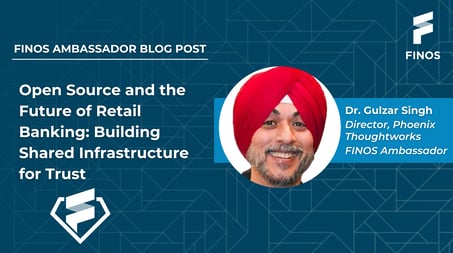
Author: Dr. Gulzar Singh, FINOS Ambassador
FINOS Good First Issues - Looking for a place to contribute? Take a look at good first issues across FINOS projects and get your feet wet in the FINOS community.
State of Open Source in Financial Services Report 2024 - Learn about what is really happening around open source in FSI.
This Week at FINOS Blog - See what is happening at FINOS each week.
FINOS Landscape - See our landscape of FINOS open source and open standard projects.
Community Calendar - Scroll through the calendar to find a meeting to join.
FINOS Slack Channels - The FINOS Slack provides our Community another public channel to discuss work in FINOS and open source in finance more generally.
Project Status Dashboard - See a live snapshot of our community contributors and activity.
Events - Check out our upcoming events or email marketing@finos.org if you'd like to partner with us or have an event idea.
FINOS Open Source in Finance Podcasts - Listen and subscribe to the first open source in fintech and banking podcasts for deeper dives on our virtual "meetup" and other topics.