
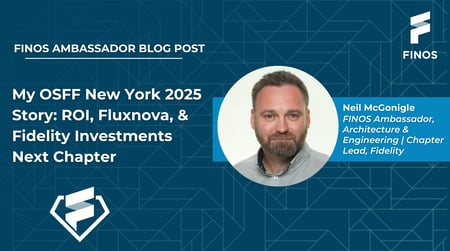
Flying into New York for the Open Source in Finance Forum (OSFF) 2025 felt different. London back in June was energising; New York felt like a milestone. Convene Brookfield Place was bright autumn perfection outside and full of focused energy inside.
What struck me immediately was continuity. I saw many of the same open source advocates I’d met a few months earlier in London, all picking up conversations about what they’d tried since then. That sense of shared progression is one of the things I value most about FINOS events. Individual journeys start to look like a coordinated industry movement — and in New York, that movement had a very clear headline: return on investment.
From Readiness to ROI: Opening Keynotes with Bhupesh and Gab
Bhupesh Vora, Chair of the FINOS Governing Board and Head of Quantitative & Technology Services Europe at RBC Capital Markets, opened with a clear shift: the industry has largely achieved open source readiness; the next chapter is measurable ROI — enhancing profitability, improving resilience, and accelerating innovation through open collaboration. It’s no longer enough to simply “allow” open source. Firms now need to learn, adopt, contribute, and help sustain shared infrastructure.
Gabriele Columbro (“Gab”), Executive Director of FINOS, echoed that theme. In London he’d challenged us to consider whether we were on the right side of history with open models in AI. In New York, he highlighted how open models have become the defining shift of the past year, and emphasised a simple choice for fintechs: help shape the future of open models, or simply consume what emerges.
Gab also welcomed dozens of new FINOS members and highlighted the pace of growth across FINOS and FINOS Labs. The message was clear: open collaboration isn’t a side experiment anymore — it’s becoming an operating model.
📽️ Watch Bhupesh’s Opening Remarks
📽️ Watch Gab's Opening Remarks
Fluxnova: A Defining Moment for Fidelity
For Fidelity, OSFF New York was a landmark checkpoint in our journey.
The headline announcement of the conference was Fluxnova — a new open source orchestration platform developed under FINOS governance and co-maintained by Fidelity, NatWest Group, Deutsche Bank, Capital One and BMO. At its core, Fluxnova is an open, production-grade process orchestration engine for BPMN and DMN workflows, with full audit trails and stateful recovery for regulated environments.
The background is important: several institutions depended on an open source project that had reached end of life. Rather than maintaining it individually, we chose to collaborate under FINOS and create a neutral, community-governed successor.
For Fidelity, this is significant. Over the last few years we’ve been growing our internal open source community, building safe contribution processes with our OSPO and Enterprise Cyber Security, and showing up consistently across the FINOS ecosystem. Fluxnova is where that groundwork became tangible: we’re co-maintaining a critical infrastructure project under a neutral foundation, shoulder to shoulder with peers.
It marks an open source maturity threshold for Fidelity. Neutral governance is no longer theoretical for us — it’s a real option for future strategic opportunities.
📽️ Watch Fluxnova Special Announcement
📽️ Watch Fluxnova Panel with Fidelity Investments, Deutsche Bank & NatWest
➡️ Get Involved with Flunxnova
A Fireside Moment: Joe, Gab, and a Platinum Commitment
A highlight for me was the fireside chat between Joe Frazier, Fidelity’s Head of Architecture and Engineering, and Gab.
Joe spoke about why Fidelity chose to bring Fluxnova to FINOS instead of maintaining an internal fork. When a critical project goes end of life, you can carry the cost alone, launch your own project, or establish neutral governance at a non-profit. In this case, neutral governance delivered the best return on investment: shared leadership, shared development responsibility, and the same great software at a far lower collective cost.
Joe also announced that Fidelity will be moving from Silver to Platinum FINOS membership next year — a clear signal that open source is central to our long-term strategy and that we intend to play a leadership role in the ecosystem. Having spent the last few years focused on engagement, recognition, and safe contribution processes, it felt like a validation point.
📽️ Watch Fluxnova Fireside Chat
Measuring What Matters: The Economics of Open
If Fluxnova was the proof point, the surrounding keynotes provided the economic context.
Frank Nagle, Chief Economist at the Linux Foundation and researcher at MIT, presented research estimating that open source contributes trillions in global economic value. His message: open source isn’t “free software” — it’s shared infrastructure with compounding returns. Contributing firms see reduced duplication, faster time to market, lower total cost of ownership, and better risk posture.
Tosha Ellison extended that conversation with the new FINOS ROI Summary report and ROI calculator, currently in early access. It helps institutions quantify what they’re already getting from FINOS membership and project usage and where contribution could unlock additional value. The message was consistent: ROI is no longer a secondary conversation — it’s the core of how firms will measure their open source strategy.
📽️ Watch Measuring What Matters: The Economics of Open
Standards, Controls, and AI: Shared Guardrails at Scale
Across both days, shared standards and controls were recurring themes. FDC3, the Common Domain Model, Common Cloud Controls (CCC), and the new Common Controls for AI Services all made important progress. For firms like Fidelity, consistent, open standards across cloud and AI are essential for avoiding fragmented interpretations of what “good” looks like.
Speaking with FINOS colleagues, including Luca Borella, it’s clear that ambassadors have a role to play in helping cloud providers align with CCC and emerging AI controls — benefiting both Fidelity and the sector.
Four Takeaways That Stuck With Me
1) ROI is now the headline, not the footnote
The conversation has shifted from “why open source?” to “how do we quantify and amplify its impact?”
2) Open source is shared infrastructure, not a hobby
Fluxnova, FDC3, CDM, and CCC signal a move to mutualise the non-differentiating layers and compete on the edges.
3) Governance and controls are accelerators, not brakes
Shared guardrails like AI Governance 2.0 and CCC are enabling faster, safer scaling.
4) Community continuity matters
Seeing the same faces from London in New York reinforced that FINOS is an ongoing community, not an annual gathering — and Fidelity’s engagement is widening through a dedicated OSPO team and deeper leadership roles.
What OSFF New York 2025 Means for Fidelity
For Fidelity, OSFF New York felt like a pivot point. We’ve spent years building internal engagement and safe contribution processes. We’ve expanded our presence across FINOS. And now, with Fluxnova and our move to Platinum membership, we’ve stepped into a more strategic, leadership-driven phase.
The path ahead includes scaling contributions, using tools like the ROI calculator to tell a clear value story, supporting alignment on shared controls, and helping other firms on their own journeys.
Leaving the final session, I felt energised and optimistic. Fidelity isn’t just in the room anymore — we’re helping shape the agenda. And that, for me, is incredibly exciting.
📽️ Watch Recorded Sessions from OSFF 2025 New York
📆 Join FINOS at the Next Open Source in Finance Forum
➡️ Get Involved with Flunxnova
> Fidelity Investments and The Linux Foundation are separate companies. Unless otherwise noted, the opinions provided are those of the speakers, not necessarily those of Fidelity Investments or its affiliates.
Author: Neil McGonigle, FINOS Ambassador, Fidelity Investments
Get Involved
FINOS Good First Issues - Looking for a place to contribute? Take a look at good first issues across FINOS projects and get your feet wet in the FINOS community.
State of Open Source in Financial Services Report - Learn about what is really happening around open source in FSI.
This Week at FINOS Blog - See what is happening at FINOS each week.
FINOS Landscape - See our landscape of FINOS open source and open standard projects.
Community Calendar - Scroll through the calendar to find a meeting to join.
FINOS Slack Channels - The FINOS Slack provides our Community another public channel to discuss work in FINOS and open source in finance more generally.
Project Status Dashboard - See a live snapshot of our community contributors and activity.
Events - Check out our upcoming events or email marketing@finos.org if you'd like to partner with us or have an event idea.
FINOS Open Source in Finance Podcasts - Listen and subscribe to the first open source in fintech and banking podcasts for deeper dives on our virtual "meetup" and other topics.