CASE STUDY: TACKING THE MULTI-CLOUD COMPLIANCE TAX
Progress from RBC, Morgan Stanley, and FINOS Common Cloud Controls


Progress from RBC, Morgan Stanley, and FINOS Common Cloud Controls
Cloud services represent critical infrastructure for modern financial institutions, yet operating across multiple cloud service providers (CSPs) introduces significant compliance and operational friction. When global financial institutions deploy workloads across Microsoft Azure, Amazon Web Services (AWS), and Google Cloud Platform (GCP), security and risk teams are forced to answer thousands of repetitive compliance questions.
Across the industry, multi-cloud assurance historically suffers from two structural fractures:
FINOS Common Cloud Controls (CCC) provides an open, vendor-agnostic framework that establishes a shared language for cloud security and governance. Rather than introducing another proprietary checklist, CCC organizes cloud security across five core components:
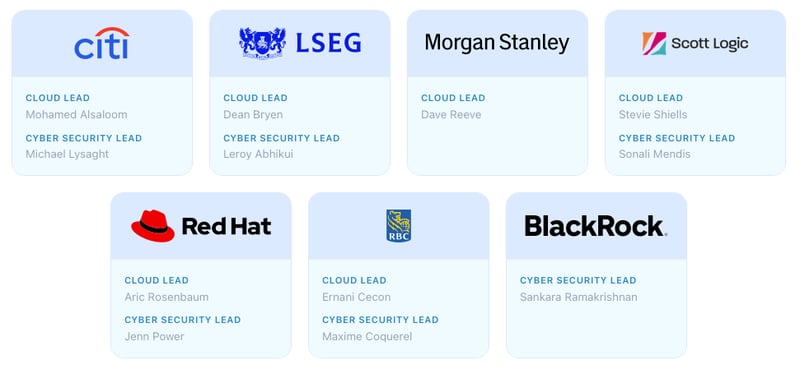
In 2026, the CCC Steering Committee was refreshed with a renewed purpose, uniting cloud leads and cybersecurity executives from key financial and technology leaders—including Citi, LSEG, Morgan Stanley, RBC, BlackRock, Red Hat, and Scott Logic.
Maxime Coquerel, Principal Cloud Security Architect at RBC and CCC Security Working Group Lead, took to the stage at OSFF Toronto in March 2026 to talk about his firm’s use of Common Cloud Controls. There, he pointed out the risk of focusing too heavily on provider-specific policy syntax rather than the underlying security objective."Sometimes we focus more on the policy creation versus on the control... when you have different implementations, you can have gaps and you need to have a framework on top of that to be sure all these gaps are covered. And that’s why CCC will help us have a high-level, agnostic control catalogue.”
— Maxime Coquerel, Principal Cloud Security Architect, RBC
He shared how requirements can be defined once at the capability layer rather than reinvented per tool. For example, the requirement mandating TLS encryption in transit for Object Storage is defined once in CCC. Technical enforcement is then delegated natively to Azure Policy on Azure Storage Accounts and to AWS Config on Amazon S3, maintaining consistent security intent across clouds.
This session is available on YouTube at: https://youtu.be/rZZGisQBzcQ
“By mapping CCC’s cloud-agnostic security control objectives to corresponding controls in RBC’s internal Cloud Security Framework, the bank establishes a clear connection between industry-standard security requirements, internal policies, and cloud-specific technical implementations. This mapping enables security teams to identify which internal controls address each CCC objective, reuse existing security assessments, and maintain traceability across cloud providers. As a result, RBC can accelerate security reviews, reduce duplicated effort, and improve consistency while ensuring alignment with internal security standards and regulatory expectations. Ultimately, CCC provides a shared security language that connects security architects, engineering teams, and governance stakeholders, supporting more efficient and scalable cloud security governance.”
— Maxime Coquerel, Principal Cloud Security Architect, RBC
Addressing the infrastructure side of the equation at OSFF London in June 2026, Dave Reeve (Cloud Lead, Morgan Stanley) highlighted the downstream platform dilemma facing organizations scaling complex compute services across clouds."If Morgan Stanley has this problem, and we do have this problem, right? I guarantee every other financial services organization is going to have exactly the same problem."
— Dave Reeve, Morgan Stanley
Managing enterprise container infrastructure requires organizations to define internal control requirements, such as private API endpoints and modern cryptographic ciphers, mapped to internal policies and NIST standards. However, Reeve detailed how executing these requirements across clouds creates operational fragmentation:
To resolve this, Reeve outlined an approach anchoring managed Kubernetes strategies to CCC:
This session is available on YouTube at https://youtu.be/NHvf31wJ2Ig
Since these community presentations, work on Common Cloud Controls has accelerated, turning these architectural goals into concrete, shipped deliverables. Organizations do not need to overhaul their entire operating model at once to benefit from this progress; member firms can adopt the framework modularly, whether upstream in architecture and risk governance, downstream in deployment validation, or across both.
Key milestones and opportunities now available to the community include:
Learn More & Get Involved
Visit the FINOS CCC project site to watch the introductory video, explore resources including catalogs and tools, participate in working roups, and contribute code and catalogs.
FINOS CCC: ccc.finos.org
FINOS Calendar: finos.org/calendar