---
title: "From AI Principles to Executable Governance: The next phase of FINOS AI"
description: Explore how the FINOS AI Fund is turning financial services AI governance into coordinated, executable technical work through open source.
image: https://www.finos.org/hubfs/Community%20Blog/2026-08-07%20-%20Next%20Phase%20of%20FINOS%20AI.png
---
[](https://finos.org)
- [Projects](https://www.finos.org/projects)
- [Artificial Intelligence (AI)](https://ai.finos.org/)
- [Common Domain Model (CDM)](https://www.finos.org/common-domain-model)
- [FDC3](https://www.finos.org/fdc3)
- [Fluxnova](https://fluxnova.finos.org)
- [FINOS Common Cloud Controls](https://www.finos.org/common-cloud-controls-project)
- [High Performance Computing (HPC)](https://hpc.finos.org)
- [OSERA](https://osera.finos.org/)
- [Open Source Readiness Initiative](https://www.finos.org/open-source-readiness)
- [OS-Climate](https://www.finos.org/os-climate)
- [Try our Projects](https://www.finos.org/project-sandbox)
- [All Projects Landscape](https://landscape.finos.org/)
- [Community](https://www.finos.org/engage-with-our-community)
- [FINOS Community Calendar](https://www.finos.org/calendar)
- [Community Quickstart](https://www.finos.org/get-involved)
- [FINOS Community Site](https://community.finos.org/)
- [Contribute](https://community.finos.org/docs/governance/Software-Projects/contribution)
- [Unable to Contribute?](https://www.finos.org/open-source-readiness)
- [Join our Slack channel](https://finos-lf.slack.com/messages/finos-community/)
- [Recognize a contributor](https://github.com/finos/community/issues/new?assignees=mcleo-d&labels=community-recognition&template=Community-Recognition.md&title=FINOS+Community+Recognition)
- [Ambassador Program](https://www.finos.org/ambassador-program)
- [Membership](https://www.finos.org/membership-benefits)
- [Members](https://www.finos.org/members)
- [Inquire](https://www.finos.org/membership-benefits#become-a-member)
- [Join](https://joinnow.platform.linuxfoundation.org/?project=finos)
- [Member ROI Summary & Calculator](https://www.finos.org/roi-report-calculator)
- [Dependency Consumption Analysis](https://www.finos.org/dependency-consumption-analysis)
- Resources
- [2025 Mission & Vision](https://www.finos.org/2024-in-review-2025-vision)
- [Research & Case Studies](https://www.finos.org/research-case-studies)
- [Training](https://training.linuxfoundation.org/finos/)
- [Open Source Maturity Model](https://osr.finos.org/docs/bok/OSMM/Introduction)
- [Contributions Live Dashboard](https://metrics.finos.org)
- [Our Github Organization](https://github.com/finos/)
- [Our Developer Toolchain](https://odp.finos.org/)
- [FINOS Store](https://store-finos.myshopify.com/)
- News & Events
- [This Week At FINOS](https://www.finos.org/this-week-at-finos)
- [Community Blog](https://www.finos.org/blog)
- [Newsletter](https://www.finos.org/newsletter)
- [Podcast: Open Source in Finance](https://www.finos.org/open-source-in-finance-podcast)
- [Press Releases](https://www.finos.org/press)
- [FINOS Events](https://www.finos.org/hosted-events)
- [Community Events](https://www.finos.org/featured-events)
- [Community Spotlight](https://www.finos.org/community-spotlight)
- [Stay Informed](https://www.finos.org/sign-up)
- [About](https://www.finos.org/about-us)
- [Stay Informed](https://www.finos.org/sign-up)
- [FAQs](https://www.finos.org/faq)
- [Contact Us](https://www.finos.org/contact-us)
- [Governing Board](https://www.finos.org/governing-board)
- [Technical Oversight Committee](https://www.finos.org/technical-oversight-committee)
- [Team](https://www.finos.org/team)
- [Governance](https://www.finos.org/governance)
- [Code of Conduct](https://www.finos.org/code-of-conduct)
- [OSFF + Videos](https://events.linuxfoundation.org/open-source-finance-forum)
- [OSFF 2026](https://www.finos.org/osff-ny-26-landing-page)
- [Fluxnova Con at OSFF NY](https://www.finos.org/fluxnova-con-at-osff-ny-2026)
- [OSFF NY Workshops](https://www.finos.org/osff-ny-2026-workshops)
- [OSFF Toronto 2026 Videos](https://www.finos.org/osff-toronto-2026-videos)
- [OSFF New York 2025 Videos](https://www.finos.org/osff-nyc-2025-videos)
- [OSFF London 2026 Videos](https://www.finos.org/osff-london-2026-videos)
- [apidays Paris 2025 Videos](https://www.finos.org/apidays)
- [Projects](https://www.finos.org/projects)
- [Artificial Intelligence (AI)](https://ai.finos.org/)
- [Common Domain Model (CDM)](https://www.finos.org/common-domain-model)
- [FDC3](https://www.finos.org/fdc3)
- [Fluxnova](https://fluxnova.finos.org)
- [FINOS Common Cloud Controls](https://www.finos.org/common-cloud-controls-project)
- [High Performance Computing (HPC)](https://hpc.finos.org)
- [OSERA](https://osera.finos.org/)
- [Open Source Readiness Initiative](https://www.finos.org/open-source-readiness)
- [OS-Climate](https://www.finos.org/os-climate)
- [Try our Projects](https://www.finos.org/project-sandbox)
- [All Projects Landscape](https://landscape.finos.org/)
- [Community](https://www.finos.org/engage-with-our-community)
- [FINOS Community Calendar](https://www.finos.org/calendar)
- [Community Quickstart](https://www.finos.org/get-involved)
- [FINOS Community Site](https://community.finos.org/)
- [Contribute](https://community.finos.org/docs/governance/Software-Projects/contribution)
- [Unable to Contribute?](https://www.finos.org/open-source-readiness)
- [Join our Slack channel](https://finos-lf.slack.com/messages/finos-community/)
- [Recognize a contributor](https://github.com/finos/community/issues/new?assignees=mcleo-d&labels=community-recognition&template=Community-Recognition.md&title=FINOS+Community+Recognition)
- [Ambassador Program](https://www.finos.org/ambassador-program)
- [Membership](https://www.finos.org/membership-benefits)
- [Members](https://www.finos.org/members)
- [Inquire](https://www.finos.org/membership-benefits#become-a-member)
- [Join](https://joinnow.platform.linuxfoundation.org/?project=finos)
- [Member ROI Summary & Calculator](https://www.finos.org/roi-report-calculator)
- [Dependency Consumption Analysis](https://www.finos.org/dependency-consumption-analysis)
- Resources
- [2025 Mission & Vision](https://www.finos.org/2024-in-review-2025-vision)
- [Research & Case Studies](https://www.finos.org/research-case-studies)
- [Training](https://training.linuxfoundation.org/finos/)
- [Open Source Maturity Model](https://osr.finos.org/docs/bok/OSMM/Introduction)
- [Contributions Live Dashboard](https://metrics.finos.org)
- [Our Github Organization](https://github.com/finos/)
- [Our Developer Toolchain](https://odp.finos.org/)
- [FINOS Store](https://store-finos.myshopify.com/)
- News & Events
- [This Week At FINOS](https://www.finos.org/this-week-at-finos)
- [Community Blog](https://www.finos.org/blog)
- [Newsletter](https://www.finos.org/newsletter)
- [Podcast: Open Source in Finance](https://www.finos.org/open-source-in-finance-podcast)
- [Press Releases](https://www.finos.org/press)
- [FINOS Events](https://www.finos.org/hosted-events)
- [Community Events](https://www.finos.org/featured-events)
- [Community Spotlight](https://www.finos.org/community-spotlight)
- [Stay Informed](https://www.finos.org/sign-up)
- [About](https://www.finos.org/about-us)
- [Stay Informed](https://www.finos.org/sign-up)
- [FAQs](https://www.finos.org/faq)
- [Contact Us](https://www.finos.org/contact-us)
- [Governing Board](https://www.finos.org/governing-board)
- [Technical Oversight Committee](https://www.finos.org/technical-oversight-committee)
- [Team](https://www.finos.org/team)
- [Governance](https://www.finos.org/governance)
- [Code of Conduct](https://www.finos.org/code-of-conduct)
- [OSFF + Videos](https://events.linuxfoundation.org/open-source-finance-forum)
- [OSFF 2026](https://www.finos.org/osff-ny-26-landing-page)
- [Fluxnova Con at OSFF NY](https://www.finos.org/fluxnova-con-at-osff-ny-2026)
- [OSFF NY Workshops](https://www.finos.org/osff-ny-2026-workshops)
- [OSFF Toronto 2026 Videos](https://www.finos.org/osff-toronto-2026-videos)
- [OSFF New York 2025 Videos](https://www.finos.org/osff-nyc-2025-videos)
- [OSFF London 2026 Videos](https://www.finos.org/osff-london-2026-videos)
- [apidays Paris 2025 Videos](https://www.finos.org/apidays)

# Community Blog
# From AI Principles to Executable Governance: The next phase of FINOS AI
August 07, 2026
[Luca Borella](https://www.finos.org/blog/author/luca-borella)
OSFF London marked an important transition for FINOS’ AI work. Since 2024, the community has developed governance frameworks, reference architectures, common controls and open source tools aimed at accelerating safe and compliant AI adoption within the financial services industry. The launch of the FINOS AI Fund now provides a clearer, industry-led mechanism for prioritizing and investing in this work, including delivering a governance as code pipeline.
## 1. The FINOS AI Fund Creates a Clearer Operating Model
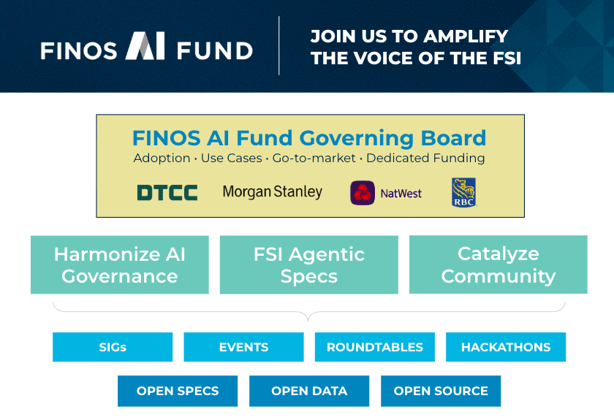
Announced during OSFF London, the [FINOS AI Fund](https://ai.finos.org/ai-fund) is a member-led fund designed to mutualize investment in shared AI challenges across financial services. It provides dedicated funding, strategic direction and project prioritization, supported by a team of subject-matter experts and developers.
The Fund’s founding members—DTCC, Morgan Stanley, NatWest and RBC—serve on its Governing Board, which sets strategic priorities, directs investment and oversees the Fund’s work. Its purpose is not to replace FINOS’s existing AI projects or communities, but to give them a shared direction and a mechanism through which industry priorities can be translated into coordinated technical work.
The current strategy can be summarized through three objectives:
- **Harmonize FSI industry AI governance** through concrete technical standards
- **Build the industry-wide specs** needed to enable intra- and inter-firm Agentic workflows
- **Catalyze community** contributions & drive adoption by bringing together a critical mass of financial services AI leaders
The wider FINOS community helps support these objectives through a number of activities: the AI Readiness Special Interest Group, working groups, training programs, roundtables, meetups and industry events. Hackathons, including the FINOS-supported Innovate.DTCC AI Hackathon, provide an additional environment in which institutions can test ideas, identify common problems and develop early prototypes
Underpinning this community and engagement is the technology itself:
- Open specifications and standards, including the [AI Governance Framework](https://air-governance-framework.finos.org/)
- Open source projects and standards such as [CALM](https://calm.finos.org/), [CCC](https://ccc.finos.org/)and [Fluxnova](http://fluxnova.finos.org)
- Open datasets and common data models, where we expect a significant increase in activity
The AI Fund does not replace these projects or communities; it supports them by providing a common direction and a mechanism for translating industry priorities into coordinated technical work.
## 2. Why Harmonizing AI Governance Is So Difficult
Financial institutions do not lack AI principles, but they do face the challenge of navigating and reconciling a complex web of obligations across their global operations.
In the UK, for example, they are likely faced with addressing the EU AI Act, FCA expectations, PRA guidance, model risk management frameworks, operational resilience requirements, data-protection obligations, cybersecurity standards and extensive internal policies.
The problem is that these requirements frequently overlap without providing concrete and consistent implementation guidance.
Determining which rules apply to a particular institution or AI system is only the starting point. The more difficult questions are operational:
- Which risks apply to this specific use case?
- Which controls should be implemented?
- Where should those controls sit within the architecture?
- How can they be tested during development?
- How can their operation be monitored in production?
- What evidence must be retained for risk, compliance, audit and regulators?
The industry therefore faces a significant “last-mile” problem.
High-level policies must be translated into technical requirements. Technical requirements must be mapped to architectures. Architectures must be connected to controls, workflows, evaluations and runtime evidence.
Without a shared implementation model, every institution is forced to perform this translation independently. The result is duplicated investment, inconsistent interpretations and governance processes that struggle to keep pace with the speed of AI development.
The [FINOS AI Governance Framework](https://air-governance-framework.finos.org/) is intended to provide a common language for this work, connecting AI use cases with risks, mitigations, regulations, reference architectures and operational practices. Its catalog already includes mappings to frameworks such as the EU AI Act, NIST, OWASP and ISO 42001.
Publishing a framework, however, is just the beginning. Governance must also become executable.
## 3. Delivering a Governance As Code Pipeline
As a member of the FINOS AI Fund Governing Board, NatWest brought forward one of the industry's most pressing challenges: how to provide enterprise-grade governance and observability for increasingly complex agentic systems.
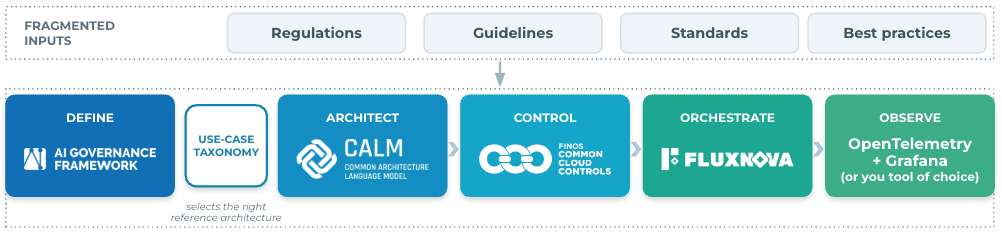
To illustrate how the industry can achieve this, we produced a Steel Thread demo: a live, end-to-end proof of concept showing how open-source standards chain together into a complete Governance as Code pipeline.
### Part 1: Designing the Architecture & Framework
Rather than using a basic "Hello World" example, the team modeled a real-world financial-services use case: automated loan approval. They mapped industry design patterns from the Agentic AI Foundation (AAIF) and AI Governance Framework controls directly into a solution architecture, demonstrating:
- **Use Case & Framework Mapping:** AI risks (such as model hallucination) are paired with concrete mitigations and controls.
- **Architecture as Code (CALM):** Architecture definitions are codified into machine-readable specs for automated policy checking.
- **Cloud Controls (CCC):** Infrastructure services—such as secure document storage for IDs and bank statements—are validated against FINOS Common Cloud Controls.
- **Process Orchestration (Fluxnova):** Agentic tasks and business logic are structured into executable workflows.
- **Observability (Grafana)**: Operational data, token usage and cost information can be collected to help answer questions such as how much an agent costs per decision.
> In this video clip, Olivier Poupeney (Field CTO, FINOS) outlines how the Steel Thread was designed—moving from a standard loan approval use case to mapping risk controls, codifying architectures with CALM and CCC, and preparing the toolset for orchestration.
### Part 2: LIVE EXECUTION & REAL-TIME OBSERVABILITY
In a live demonstration, abstract governance policy became functional software:
- **Executable Multi-Agent Workflows:** Fluxnova orchestrates data extraction, fraud detection, compliance reviews, and credit risk scoring agents.
- **Dynamic Human-in-the-Loop Controls:** If an agent flags a high AI risk score or low confidence output, the workflow automatically routes to a human reviewer before clearing compliance. Low-risk applications are auto-approved.
- **Auditable Evidence:** Every workflow execution generates a transparent decision trail that compliance and audit teams can inspect.
- **Granular Observability & Tokenomics:** OpenTelemetry and Grafana track operational metrics in real time—monitoring success ratios, API response latency, and token consumption down to individual tasks and agents.
> Watch the live execution of the multi-agent loan approval engine. At OSFF London, Olivier Poupeney and James McLeod (NatWest Group) demonstrated real-time workflow orchestration, with automated human-in-the-loop review triggers and live token tracking in Grafana.
As James McLeod noted during the session, demonstrating a working, observable engineering pipeline makes the case for enterprise AI governance "a far easier sell" to stakeholders.
## 4. What Comes Next: Get Involved
The Steel Thread is an important proof of concept, but it is only the beginning. In H2, the FINOS community will work on expanding the underlying specifications, validating them through additional use cases and making them easier for institutions to adopt.
The community will continue developing the Use Case Taxonomy connecting the different elements of the AI Governance Framework. This taxonomy will provide the connective tissue between AIGF and downstream projects such as CALM, Common Cloud Controls, Gemara and Fluxnova.
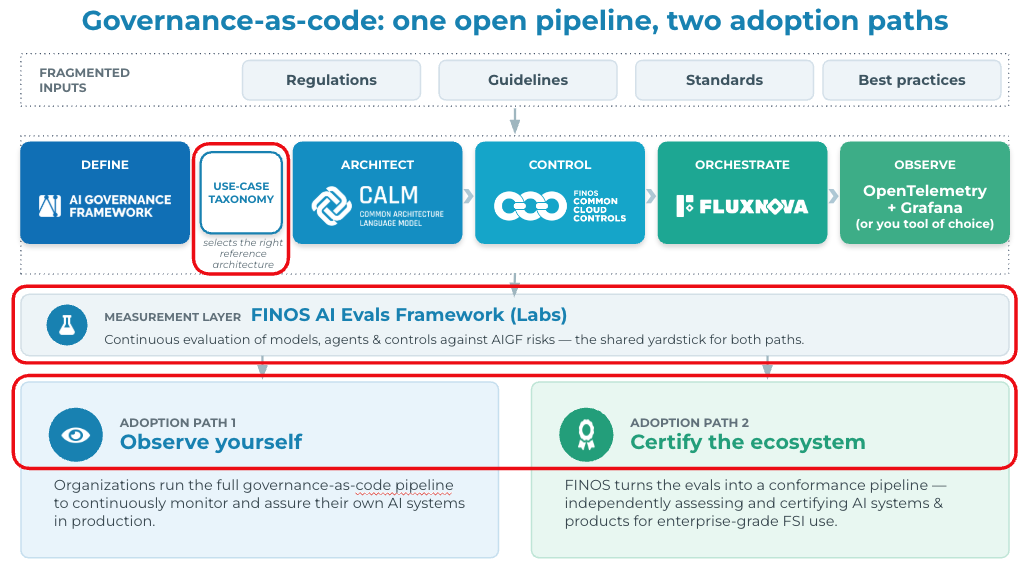
A new Use Case Working Group will be established to bring together financial institutions and project maintainers around representative industry use cases. These use cases will help the community test the ability of multiple FINOS AI projects to operate together, and identify where specifications or technical components are still missing.
### **OPPORTUNITIES TO GET INVOLVED with FINOS AI**
---
## AI Governance Framework
Are you interested in adopting or contributing to the AI Governance Framework?
➡️ **[JOIN THE NEXT AIGF WORKING SESSION](https://www.google.com/url?q=https://zoom-lfx.platform.linuxfoundation.org/meeting/97158459687?password%3D62a83d0b-7b19-416d-8250-e5bcf9f7640b%26invite%3Dtrue&sa=D&source=docs&ust=1786133610588544&usg=AOvVaw0KtgB9ff6aBThyrMQDd40D)**
---
## Build the FINOS AI Evals Framework
AI governance cannot rely solely on controls defined during design. Institutions must also evaluate how models and agents behave before deployment and throughout their operational lifecycle.
The FINOS AI Evals Framework will explore common financial services approaches to evaluating AI systems. The objective is not simply to produce another evaluation library; it is to establish a shared financial services approach for deciding what should be evaluated, which evidence should be retained, and how evaluation results can feed back into governance and operational processes.
**Interested in contributing or becoming a project maintainer?**
➡️ [**COMMENT ON THE PROJECT ISSUE**](https://github.com/finos-labs/ai-evals-framework/discussions/29)
---
## Expand AIGF Training and Define a Conformance Path
Following the initial AIGF Leader Training workshops, the community is working with Linux Foundation Education to make the curriculum available through a scalable e-learning format.
In parallel, we will begin to explore what an AIGF conformance program could look like. Over time, a conformance approach could allow organizations, platforms or implementation patterns to demonstrate alignment with agreed AIGF requirements through consistent and transparent assessment criteria.
**Interested in future training, e-learning or the conformance program?**
➡️ [**REGISTER YOUR INTEREST IN AIGF TRAINING HERE**](https://www.finos.org/ai-governance-framework-training)
*Author: Luca Borella, FINOS*
---
### **Get Involved**
[**FINOS Good First Issues**](https://github.com/search?q=org%3Afinos+is%3Aopen+label%3A%22good+first+issue%22&unscoped_q=is%3Aopen+label%3A%22good+first+issue%22) - Looking for a place to contribute? Take a look at good first issues across FINOS projects and get your feet wet in the FINOS community.
[State of Open Source in Financial Services Report](https://www.finos.org/state-of-open-source-in-financial-services-2024) - Learn about what is really happening around open source in FSI.
[**This Week at FINOS Blog**](https://finos.org/this-week-at-finos?utm_campaign=20210312%20Newsletter&utm_source=hs_email&utm_medium=email&_hsenc=p2ANqtz-9Zgn2rjI2nlAwd4d3Mf5LKC8CmqUJ1wzZYFYOTKgWIuCxaowceMq1Y0ZiFrWPAcWoelavo) - See what is happening at FINOS each week.
[**FINOS Landscape**](https://landscape.finos.org/?utm_campaign=20210312%20Newsletter&utm_source=hs_email&utm_medium=email&_hsenc=p2ANqtz-9Zgn2rjI2nlAwd4d3Mf5LKC8CmqUJ1wzZYFYOTKgWIuCxaowceMq1Y0ZiFrWPAcWoelavo) - See our landscape of FINOS open source and open standard projects.
[**Community Calendar**](https://calendar.finos.org)- Scroll through the calendar to find a meeting to join.
[**FINOS Slack Channels**](https://finos.org/blog/finos-announces-new-community-slack?utm_campaign=20210428%20-%20FINOS%20All%20Community%20Call%20-%20Q2%202021&utm_source=hs_email&utm_medium=email&_hsenc=p2ANqtz-9Zgn2rjI2nlAwd4d3Mf5LKC8CmqUJ1wzZYFYOTKgWIuCxaowceMq1Y0ZiFrWPAcWoelavo) - The FINOS Slack provides our Community another public channel to discuss work in FINOS and open source in finance more generally.
[**Project Status Dashboard**](https://metrics.finos.org/goto/7bfcb03f027a1406c997d731d4715ea7?utm_campaign=20210312%20Newsletter&utm_source=hs_email&utm_medium=email&_hsenc=p2ANqtz-9Zgn2rjI2nlAwd4d3Mf5LKC8CmqUJ1wzZYFYOTKgWIuCxaowceMq1Y0ZiFrWPAcWoelavo) - See a live snapshot of our community contributors and activity.
[**Events**](https://finos.org/news-and-events?utm_campaign=20210312%20Newsletter&utm_source=hs_email&utm_medium=email&_hsenc=p2ANqtz-9Zgn2rjI2nlAwd4d3Mf5LKC8CmqUJ1wzZYFYOTKgWIuCxaowceMq1Y0ZiFrWPAcWoelavo) - Check out our upcoming events or email [**marketing@finos.org**](mailto:marketing@finos.org) if you'd like to partner with us or have an event idea.
[**FINOS Open Source in Finance Podcasts**](https://anchor.fm/finos) - Listen and subscribe to the first open source in fintech and banking podcasts for deeper dives on our virtual "meetup" and other topics.
### Share this:
- [Tweet](https://twitter.com/share)
[← My OSFF London 2026 Story: Heat, Human Connection, and the Agentic Shift](https://www.finos.org/blog/my-osff-london-2026-story)
[2026 Q3 FINOS All Community Call →](https://www.finos.org/blog/2026-q3-finos-all-community-call)
[](https://www.finos.org/)
[](https://twitter.com/finosfoundation) [](https://finos.github.io) [](https://www.linkedin.com/company/finosfoundation) [](https://www.slideshare.net/finosfoundation) [](https://www.youtube.com/channel/UCfJAdRALzJ7J7snubrb_Y-Q)
[Contact Us](https://www.finos.org/contact-us)
[info@finos.org](mailto:info@finos.org)
+1 (650) 665-9773
[Privacy |](https://www.finos.org/privacy-policy)[Terms of Service |](https://www.finos.org/terms-of-service)[Community Code of Conduct |](https://www.finos.org/code-of-conduct)[Email Preferences](https://www.finos.org/hs/manage-preferences/unsubscribe-simple)
```json
{
"@context" : "https://schema.org",
"@type" : "VideoObject",
"caption" : {
"@type" : "MediaObject",
"contentUrl" : "https://www.finos.org/media-transcripts/218952798579/en.vtt",
"inLanguage" : "en",
"name" : "en Captions"
},
"contentUrl" : "https://2419532.fs1.hubspotusercontent-na1.net/hubfs/2419532/video_assets/218952798579/inherited/web_optimized.mp4",
"dateModified" : "2026-08-07T23:33:19.478Z",
"duration" : "PT7M38S",
"height" : 720,
"name" : "AI Governance Unlocked - Designing the Architecture & Framework",
"thumbnailUrl" : "https://www.finos.org/hubfs/AI%20Governance%20Unlocked%20-%20Designing%20the%20Architecture%20&%20Framework.mp4/medium.jpg",
"uploadDate" : "2026-08-07T23:33:02.422Z",
"width" : 1280
}
```
```json
{
"@context" : "https://schema.org",
"@type" : "VideoObject",
"caption" : {
"@type" : "MediaObject",
"contentUrl" : "https://www.finos.org/media-transcripts/218952798728/en.vtt",
"inLanguage" : "en",
"name" : "en Captions"
},
"contentUrl" : "https://2419532.fs1.hubspotusercontent-na1.net/hubfs/2419532/video_assets/218952798728/inherited/web_optimized.mp4",
"dateModified" : "2026-08-07T23:36:53.277Z",
"duration" : "PT13M34S",
"height" : 720,
"name" : "AI Governance Unlocked - Live Execution & Real-Time Observability",
"thumbnailUrl" : "https://www.finos.org/hubfs/AI%20Governance%20Unlocked%20-%20Live%20Execution%20&%20Real-Time%20Observability.mp4/medium.jpg",
"uploadDate" : "2026-08-07T23:36:30.843Z",
"width" : 1280
}
```